The drive from the Nisqually entrance takes about an hour if you stop at Longmire. Most people don’t stop. They push on to Paradise, because at 5,400 feet on the southern flank of Mount Rainier, the road crests a ridge and the mountain reveals itself all at once: 14,411 feet of glaciated volcano, close enough that the Nisqually Glacier fills your windshield. Get out of the car and the air is cold and sharp, and below the snowline the meadows run with paintbrush, lupine, and avalanche lilies in a color palette that doesn’t photograph right.
Paradise is the most visited area in Mount Rainier National Park, and it earns that status. It puts genuine alpine terrain within walking distance of a parking lot, offers trails for nearly every fitness level, and delivers a visitor center with hot food and ranger programs for when the afternoon clouds roll in. This guide covers everything you need to plan a day at Paradise: the permit system, the best trails, the wildflower window, and what to expect in winter.
What Makes Paradise Worth the Drive
Most volcanic peaks in the Cascades are wilderness destinations. You earn the views with miles of trail and significant elevation gain before you reach subalpine terrain. Paradise is the rare exception: a true alpine environment you drive to within a five-minute walk of a full-service visitor center.
That accessibility draws over a million people to Mount Rainier National Park each year, but it doesn’t soften the terrain. The open meadows above the Henry M. Jackson Visitor Center are real subalpine ecology, established over centuries. Stay on marked trails. A single footstep off the path compresses soil and destroys ground cover that can take 50 years to recover.
The mountain anchors every view from Paradise. At 14,411 feet, Rainier is the highest peak in the Cascades and holds more permanent glacial ice than any other mountain in the contiguous United States. From the parking lot, you can trace the Nisqually and Paradise glaciers with your eye. On clear days, the standard summit route is visible as a pale ribbon climbing the Muir Snowfield to Camp Muir at 10,000 feet.
Getting to Paradise: Roads, Parking, and Timed Entry
Paradise is reached via two routes. From the west, enter at the Nisqually (southwest) gate and drive the Longmire Road uphill to Paradise. From the east, use the Stevens Canyon entrance. Both routes are paved and open seasonally. The Nisqually gate stays open year-round; the Stevens Canyon approach closes in winter.
From Seattle, the drive is about 90 miles and takes 2 to 2.5 hours depending on traffic through Tacoma. From Portland, plan on 2.5 hours via Highway 12 through Packwood and the southeast corner of the park.
Timed entry permits are required for Paradise from late May through Labor Day. Permits are released on recreation.gov in two windows: 30 days in advance at midnight Pacific, and the day before at 7am. The 30-day release sells out in minutes. Set a calendar reminder. Day-before slots are available more often but are not guaranteed.
Permit holders get a guaranteed parking space in the Paradise lots. Visitors without permits may be turned away at the entrance or redirected to an overflow lot at Cougar Rock Campground (8 miles below Paradise), where a seasonal shuttle runs on summer weekends for $4 per person. Check current road and permit conditions on the NPS Mount Rainier plan-your-visit page before you leave home.
Park entry is $35 per vehicle, valid for 7 days. America the Beautiful passes are accepted at the gate.
The Best Hikes from Paradise at Mount Rainier
Paradise sits at the center of an interconnected trail network. The most popular circuit is the Skyline Trail Loop, which covers the upper Paradise basin in 5.5 miles. Shorter options reach the same views with less mileage. For the complete range of trails across the park, including routes at Sunrise and Mowich Lake, see our Mount Rainier day hikes guide.
Alta Vista Summit Trail
Distance: 1.7 miles round trip | Elevation gain: 500 feet | Start: Upper Paradise parking lot
The fastest high-quality payoff on the south side of the mountain. The trail switchbacks through open meadow to a rocky knoll with clear views south to the Tatoosh Range and north toward the summit. A good first hike if you’re timing your visit around afternoon permits or want to scout the terrain before committing to something longer. The angle from Alta Vista shifts the mountain’s profile noticeably: the Nisqually Glacier reads directly above you rather than off to one side.
Skyline Trail Loop
Distance: 5.5 miles | Elevation gain: 1,700 feet | Start: Upper Paradise parking lot
The full circuit of the upper Paradise bowl. The standard counterclockwise approach: take the Skyline Trail north to Panorama Point at 6,800 feet, then cut across the Golden Gate Trail and descend the High Skyline back to the visitor center. Panorama Point delivers the widest views available from any maintained trail on this side of the mountain, including a long look east across the White River valley toward Sunrise.
The section between Panorama Point and the Pebble Creek crossing crosses permanent snowfields into late July. Microspikes are worth carrying before mid-August. Ice axes are not needed on this trail under normal conditions. Poles are helpful on the steeper sections when snow is firm.
Dead Horse Creek Trail
Distance: 3.5 miles round trip | Elevation gain: 900 feet | Start: Lower Paradise parking lot
A quieter alternative to the Skyline Trail that reaches the same upper meadows via a different ridgeline. The lower section follows Dead Horse Creek through a dense wildflower corridor before opening into the broad subalpine basin above. If the upper lot is full on a busy weekend, start here instead: you’ll find fewer people on the initial climb and join the main trail crowd only when you reach the upper meadows.
Wildflower Season: Timing Your Visit
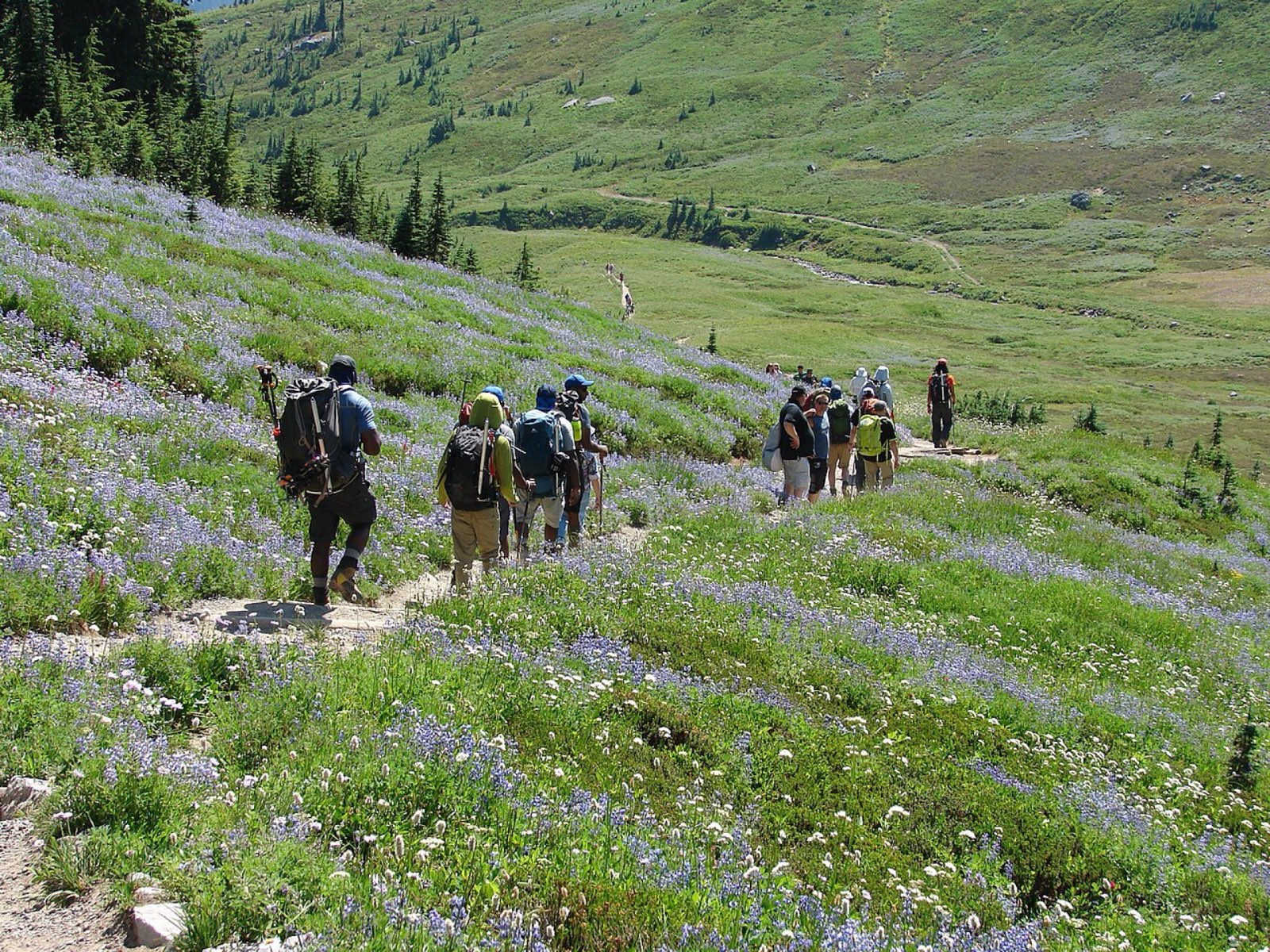
The wildflower window at Paradise typically runs from mid-July through mid-August. The exact dates shift by one to two weeks depending on winter snowpack. A heavy snow year (common after La Nina winters) pushes the peak toward late July or early August. A low-snow year opens the meadows by early July.
The main species: subalpine lupine (purple-blue), Indian paintbrush (scarlet and magenta), Sitka valerian (white clusters), avalanche lily (white, emerging directly through retreating snow at the upper elevations), and western anemone. Species mix changes with elevation. The lower trail sections near the visitor center bloom first, usually two to three weeks ahead of the terrain at 6,000 feet.
For current conditions, the NPS wildflower report for Mount Rainier is updated weekly during summer by park rangers. It breaks down what is blooming at each elevation band. Check it the week before your trip.
For broader trip timing, including the best windows for Rainier alongside fall foliage in the Cascades, ski season at Crystal Mountain, and cherry blossoms in Seattle, our month-by-month guide to visiting Washington covers the full calendar.
The Henry M. Jackson Visitor Center
The main Paradise visitor center is open daily from mid-May through mid-October, and on weekends only from late October through April (weather permitting). Summer hours are typically 10am to 6pm. Confirm current hours on the NPS website before visiting in shoulder season.
Inside: interpretive displays covering the park’s glaciology and volcanic history, a theater with the park film, restrooms, a cafeteria serving hot food (soup, burgers, sandwiches), and a gift shop. Ranger-led programs depart from the visitor center several times each day in summer. Programs vary by day but typically include a 1-hour nature walk and a shorter geology talk focused on the volcano and its ice fields.
The Paradise Inn sits adjacent to the visitor center. Built in 1917 from old-growth timber, it’s a National Historic Landmark worth stepping into even if you’re not staying. The great hall has 14-foot ceilings, a massive stone fireplace, and hand-crafted furniture built by a German carpenter named Hans Fraehnke during a single winter at the inn. Summer room rates start around $200 per night. Book far in advance via the park concessioner’s site.
Winter at Paradise: Snowshoeing and Ski Touring
Paradise averages 680 inches of annual snowfall. It held the world record for most snow in a single season from 1972 until 1998. In winter, the meadow trails become snowshoe and ski touring routes, and the upper parking lot functions as a staging area for climbers attempting the summit via the Muir Snowfield.
The park operates a designated snow play area on the lower Paradise slopes on winter weekends. Snowshoeing is free with park entry. Rangers lead guided snowshoe tours from the visitor center on weekends from January through March. Rental snowshoes are available at the visitor center for around $30 per day.
Backcountry ski touring and splitboarding in the Paradise basin require a free overnight permit, available at the Jackson Visitor Center. The Muir Snowfield tour (Camp Muir and back) is the most popular objective: 4,600 feet of elevation gain on open snow, requiring solid avalanche awareness and full winter gear. This is not a beginner route.
Road closures happen several times each winter during storm cycles. Check current road conditions on the NPS website before driving up between November and April.
Practical Tips Before You Go
Fees: $35 per vehicle, valid 7 days. America the Beautiful pass covers this.
Food on-site: The visitor center cafeteria is the only food option at Paradise. It’s reliable but limited. Pack your own lunch if you care about variety.
Cell service: Essentially nonexistent above Longmire. Download offline trail maps in Gaia GPS or Avenza before leaving the entrance area.
Weather: Paradise creates its own microclimate. Temperature drops 20 to 30 degrees in under an hour when cloud layers move through. Carry a waterproof shell regardless of the morning forecast. Afternoon thunderstorms build quickly in July and August. Plan to be below the snowline by 2pm on days with building cumulus.
Dogs: Not permitted on Paradise trails above the parking lot. Dogs are allowed in parking areas and on paved walkways near the visitor center.
Altitude: At 5,400 feet, Paradise sits above the level where some visitors from sea level notice mild altitude effects. Drink water throughout the day and pace yourself for the first hour of any hike.
Planning Your Day at Paradise
Arrive before 9am in peak season. By 10am on a summer weekend, permits fill and parking turns into a competition. An early start gets you the meadows in the quiet morning light, with most of the wildflower photographs belonging to you.
Short day (2 to 3 hours): Alta Vista Summit Trail plus the lower meadow nature trail. Start and finish at the visitor center. Cover about 3 miles total.
Full day (6 to 8 hours): Skyline Trail Loop in the morning (done by 1pm), lunch at the cafeteria, then Dead Horse Creek Trail in the afternoon for a different perspective on the basin. You’ll cover the full range of the Paradise terrain without retracing your steps.
For the western side of the park, including the Hoh Rain Forest and the Pacific coast, the Olympic Peninsula road trip itinerary covers a separate Washington landscape that pairs well with a Rainier visit on a longer trip.
Paradise is the most visited point in Washington’s most visited national park. On a clear July morning, with the glaciers catching the sun and the meadows at peak color, it’s easy to see why.