Planning a trip to Mount Rainier? Weather should be the first thing you research, not the last. The volcano stands so far above its surroundings that it creates its own weather systems, and the swings between elevations are dramatic: it can be 70 degrees and sunny at Longmire while Paradise, 2,600 feet higher, is socked in fog or receiving fresh snow. Mount Rainier weather varies not just by season but by hour, by which side of the mountain you’re on, and by how far up the road you drive. This guide breaks it all down.
When Is the Best Time to Visit Mount Rainier?
For most visitors, July through mid-September is the prime window. Snow has cleared from the main hiking trails by early July in most years, the wildflowers at Paradise peak from mid-July through late August, and the roads to both Paradise and Sunrise are fully open.
September holds up well. Crowds thin after Labor Day, the weather stays dry through most of the month, and the timed entry permits required for Paradise and Sunrise mid-June through Labor Day are no longer needed. You can drive up without a reservation.
For snowshoers and winter visitors, December through February is the season, with Paradise receiving some of the deepest seasonal snowpack in the contiguous United States.
Spring (April and May) rewards patient travelers. Trails at elevation are still buried under many feet of snow, but lower routes through old-growth forest at Longmire are accessible, and the crowds haven’t arrived.
Summer Weather at Mount Rainier (June–September)
June is a shoulder month. The Sunrise Road, which reaches 6,400 feet, typically doesn’t open until early July. Paradise, at 5,400 feet, is accessible year-round, but the upper meadows may still be under several feet of snow through mid-June. Trails like the Skyline Loop are often passable with microspikes early in the month, but expect route-finding challenges and wet postholing conditions.
July through August is when Mount Rainier delivers on its reputation. Daytime highs at Paradise typically run from the low 50s to mid-60s Fahrenheit. At Longmire (2,761 feet), expect 65–75 degrees on clear days. At Sunrise (6,400 feet), temperatures rarely exceed 65 even at peak summer, and the air carries a chill even when the sun is strong.
Afternoon thunderstorms are a real factor in July and August. Pacific frontal systems push through less frequently in summer, but convective storms build over the mountain on warm afternoons as moisture from the heated lowlands rises and cools rapidly at elevation. If you’re planning longer routes like the Skyline Trail loop from Paradise (9 miles, 1,700 feet of gain) or the hike to Camp Muir (4.4 miles one way to 10,080 feet), start early. Summit-bid parties leave Paradise by 4 or 5am for this reason.
The wildflower peak at Paradise runs from roughly mid-July to early August, with paintbrush, lupine, and avalanche lily covering the open slopes below the snowline. For detailed trail conditions and the best routes to reach the meadows, the Mount Rainier day hikes guide covers what each route looks like by month.
September is the dark horse month. The weather window often holds through mid-September, the mountain is frequently clear in morning hours, and the permit requirement ends. The wildflowers are past, but the alpine views are unchanged, and the early color on the shrubby vegetation below Sunrise adds texture to the slopes.
Fall at Mount Rainier (October–November)
Early October brings larch gold to the Sunrise area. The subalpine larches on the slopes above Frozen Lake and along the Sourdough Ridge Trail turn a vivid amber in late September through early October. On a clear morning, with the larch color against a fresh dusting of snow on the summit pyramid, it’s one of the more striking images the Pacific Northwest produces.
The Sunrise Road typically closes in late October, sometimes earlier if early snowfall closes it ahead of schedule. Paradise stays accessible year-round (the road is plowed continuously), but upper meadow trails become buried by mid-October.
November is transition month. Snowfall at Paradise increases sharply. Longmire remains open and is worth visiting for the old-growth forest walks and the Thomas Longmire Museum, but much of the park above 4,000 feet is closed to casual day visitors. Check the National Park Service road and conditions page before leaving home in fall. Closures happen overnight.
Winter at Mount Rainier (December–March)
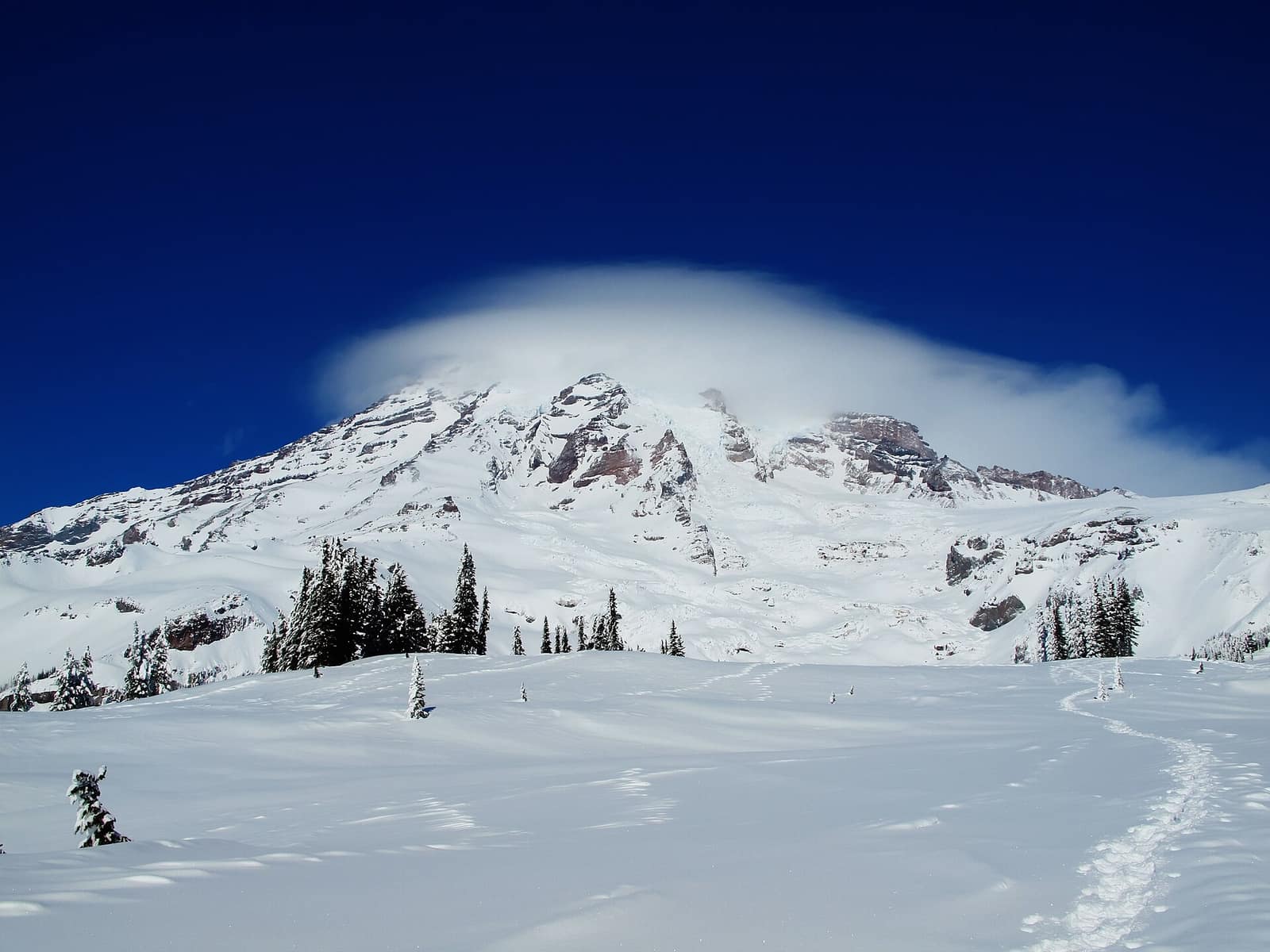
Paradise holds a world record: 1,122 inches of snowfall in a single season (1971–72). The average annual snowfall at the Paradise ranger station is around 640 inches. On a January weekend, there can be 15 to 20 feet of snow sitting on the ground around the Henry M. Jackson Visitor Center.
That sounds like a deterrent. It’s the draw. Paradise in winter is one of the most dramatic snow landscapes in Washington State. The Henry M. Jackson Visitor Center is open on weekends and select weekdays (check nps.gov/mora for current hours), and the Skyline Trail area is used for snowshoeing and cross-country skiing. Ranger-led snowshoe walks run on winter weekends, weather permitting, and are free with a park pass.
Road conditions are the main variable. The Paradise Road (Highway 706 through the Nisqually entrance) is plowed and passable year-round, but the park requires chains when the roadway is icy. Carry chains even with all-wheel drive. Rangers at the park entrance will turn vehicles back without them when conditions deteriorate.
Temperatures at Paradise in January typically run from the mid-20s to low 40s Fahrenheit during the day. Wind exposure at the visitor center and along the ridge above it amplifies the cold.
For context on how Rainier’s winter fits into Washington’s broader seasonal calendar, the month-by-month Washington travel guide covers what’s happening across the state alongside what each season at the park looks like.
Spring at Mount Rainier (April–May)
April at Paradise typically means 10 to 20 feet of snow at the visitor center, depending on how heavy the winter was. The Henry M. Jackson Visitor Center operates on weekend hours, and the lower trails from Longmire are accessible for snowshoeing and cold-weather walking.
The Nisqually River valley and the forest around Longmire begins greening up in April. Trail of the Shadows, a 0.7-mile loop from the Longmire complex, is usually accessible early in the month and winds through thermal springs and stands of old-growth Sitka spruce and western red cedar. It’s an underused corner of the park that most visitors drive past on their way to Paradise.
May accelerates the transition. The Paradise Road is typically open throughout May, but late-season storms can close it temporarily. Wildflowers appear first at Longmire and the lower Carbon River area, while the high country remains buried. The advantage of a May visit: no permits required, parking is available on weekday mornings, and you can have Paradise nearly to yourself before the summer crowds arrive.
Understanding Mount Rainier’s Microclimates
The park spans elevations from about 1,600 feet at the Carbon River entrance to 14,411 feet at the summit. That 12,800-foot range means multiple climate zones within the same park visit, and conditions can shift substantially between entrances.
Longmire sits in the Nisqually River valley at 2,761 feet. It receives less snowfall than Paradise, runs warmer in summer, and is often your last glimpse of sunshine before clouds settle around the mountain. When weather forecasts show a 50% chance of rain, Longmire might stay clear while Paradise disappears into overcast.
Paradise at 5,400 feet marks the lower boundary of the true subalpine zone. Snow can fall at Paradise in any month of the year, though July and August see it only as brief flurries. Rain is always a possibility.
Sunrise at 6,400 feet is the highest road-accessible point in the park and sits on the drier eastern flank. The east side of the Cascades receives considerably less precipitation than the west because incoming Pacific storms lose much of their moisture crossing the mountain range. This is why Sunrise often stays sunnier when storms push in from the west and Paradise disappears into clouds. The trade-off: the Sunrise Road is only open from early July through late October. For detailed planning information on park facilities and what’s open at each elevation, the Mount Rainier visitor information page has current operating schedules.
For planning a day specifically at Paradise, including the permit system and seasonal trail access, the Paradise visitor guide covers conditions by month and what to expect at the Henry M. Jackson Visitor Center.
What to Pack for Mount Rainier
Layers are essential at any time of year. The temperature difference between the car park at the Nisqually entrance and the top of the Skyline Trail can be 15–20 degrees Fahrenheit on a warm summer day, and that gap grows fast if clouds move in or afternoon thunderstorms develop.
For summer (July–September):
- Hardshell rain jacket, always
- Insulating mid-layer (fleece or light down) for above 5,000 feet
- Sunscreen and sunglasses, even on cloudy days (UV reflects off snow)
- Sturdy hiking boots with ankle support and good grip
- Start times before 9am for any route above treeline
For shoulder seasons (June, October):
- Microspikes for trails at Paradise or Sunrise
- Waterproof boots rather than trail runners
- Additional insulating layers and waterproof pants
For winter:
- Snowshoes (available for rent at the Paradise visitor center on weekends)
- Gaiters and waterproof pants
- Chains for your vehicle (required in icy conditions)
- Warm layers rated to 20°F or below
Current trail conditions and any closures are updated regularly at nps.gov/mora. Check it the evening before your visit, not the morning of.
Getting to Mount Rainier
Most visitors enter through the Nisqually entrance (southwest corner) off Highway 706, reached from the town of Ashford. This is the year-round entrance and the most direct route from Seattle (roughly 2 hours via I-5 south to Highway 7).
The White River entrance (northeast) leads to Sunrise and Carbon River areas and is open summer and early fall only. Reach it via Highway 410 from Enumclaw to the west, or from Yakima to the east.
Longmire, just inside the Nisqually entrance, is the year-round services hub: the Wilderness Information Center for permit and backcountry info, a small general store, and the historic National Park Inn. Plan fuel stops in Ashford or Eatonville before entering the park. There are no gas stations inside the park boundary.
For a full rundown of the park’s trails, from easy meadow loops to multi-day Wonderland Trail segments, the Mount Rainier trails guide covers difficulty ratings, trailhead locations, and seasonal access for each route.
Hero photo: Mount Rainier Winter by Matthew Zalewski, licensed CC BY-SA 4.0, via Wikimedia Commons. Resized.