The peak for Mount Rainier National Park wildflowers is not a single date you circle on the calendar. It’s a wave that rolls upward through the park over six weeks, starting near Longmire at 2,800 feet in late June and cresting at Sunrise and Spray Park by late July and early August. By the time the high meadows hit full color, the lower forest trails have already gone back to green. Understanding that elevation gradient is the whole game: somewhere in the park has good bloom from late June through mid-August, and knowing where saves you a wasted trip.
This guide covers the four main wildflower areas, what’s blooming in each, and the timing and logistics you need to plan around peak color.
When Mount Rainier National Park Wildflowers Peak
The bloom follows elevation more reliably than the calendar. A rough pattern for most years:
- Late June to early July: Lower trails near Longmire (2,800 ft) and the Carbon River area (1,700 ft). Trillium, wood violet, and Pacific trillium in forested sections. Limited open meadow here, but far fewer people.
- Early to mid-July: Mid-elevation areas open. The Naches Peak Loop at Chinook Pass (5,400 ft) hits peak bloom around July 10 to 20 in most years. Tipsoo Lake bloom reaches full color around the same window.
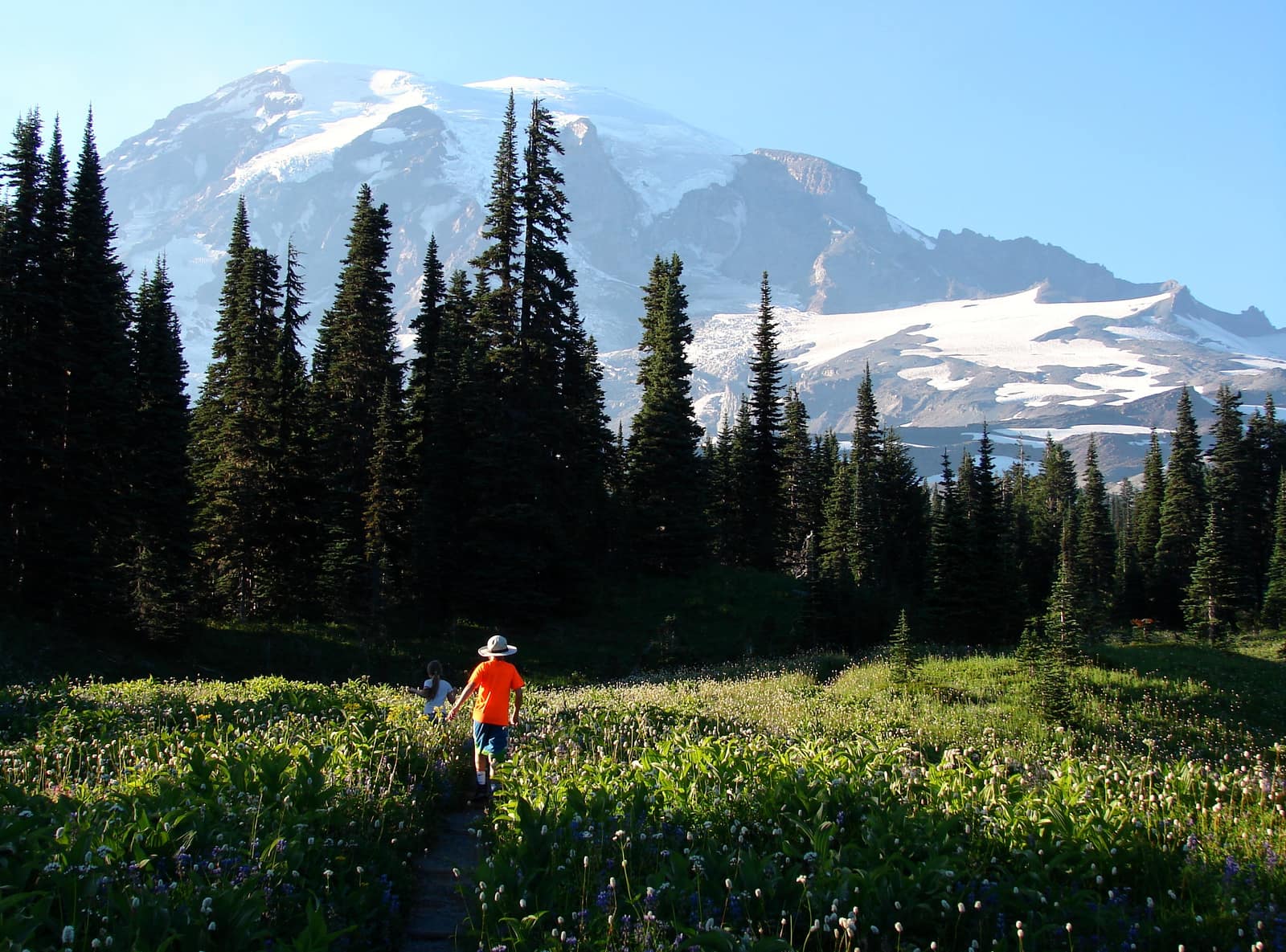
- Mid-July to early August: Paradise (5,400 ft) and Spray Park (5,800 ft) hit the full-color window. Lupine, Indian paintbrush, and bistort fill the open basins. This is the main event for most visitors.
- Late July to mid-August: Sunrise (6,400 ft) and the Burroughs Mountain ridgeline bloom last, for the shortest window. Higher elevation means a later, briefer season.
Snow year makes a meaningful difference. A heavy winter (common in La Niña cycles) can push every date back by two to three weeks. The NPS wildflower report for Mount Rainier is updated weekly during summer by park rangers and breaks down conditions by elevation band. Check it the week before your trip rather than relying on general timing alone.
Paradise: The Park’s Main Wildflower Basin
Paradise earns its traffic during wildflower season. The Henry M. Jackson Visitor Center sits at 5,400 feet on the park’s south side, and the meadow system around it runs from the parking lot to the base of the Muir Snowfield in an almost continuous carpet of color at peak. You don’t have to earn the views with miles of trail before the flowers start. They begin 50 feet from your car.
The most productive trails for wildflower viewing:
Skyline Trail Loop
Distance: 5.5 miles | Elevation gain: 1,700 feet | Start: Upper Paradise parking lot
The full circuit of the Paradise basin gives you the widest range of bloom zones. The lower sections near Dead Horse Creek flood with lupine and Sitka valerian in mid-July. Above Panorama Point at 6,800 feet, flowers thin as rock and ice take over, but the transition between subalpine meadow and alpine terrain is itself worth seeing. Counterclockwise is the standard direction: Skyline Trail north to Panorama Point, then back via the High Skyline. Budget 3.5 to 4 hours.
Alta Vista Summit Trail
Distance: 1.7 miles round trip | Elevation gain: 500 feet | Start: Upper Paradise parking lot
The fastest route to a real wildflower view from Paradise. The trail switchbacks through open meadow to a rocky knoll with clear lines of sight south to the Tatoosh Range and north toward the Nisqually Glacier. Good choice if you have two hours or want to read the terrain before committing to something longer.
Dead Horse Creek Trail
Distance: 3.5 miles round trip | Elevation gain: 900 feet | Start: Lower Paradise parking lot
A quieter approach to the upper Paradise bowl than the Skyline Trail. The lower section follows the creek through a dense wildflower corridor before opening onto the main meadow. Fewer people on the initial climb, same views when you get to the top.
Timed entry permits are required for Paradise from late May through Labor Day. Book through recreation.gov up to 30 days in advance. The 30-day window sells out in minutes. For full Paradise logistics, including the visitor center, winter access, and where to stay, the Paradise visitor guide has everything in one place.
Naches Peak Loop and Tipsoo Lake
The Naches Peak Loop at Chinook Pass is the most efficient wildflower hike in the park for visitors driving from Eastern Washington or the Yakima Valley. The trailhead sits directly on Highway 410, and the 3.5-mile loop maintains good bloom along most of its length. Half the trail runs inside the park boundary; the other half crosses into the Norse Peak Wilderness. The variety of terrain in a short loop makes the distance feel larger than it is.
The loop passes Tipsoo Lake, where a wide view of Rainier reflects in the water against the flower fields. Peak season at Naches Peak typically runs two to three weeks ahead of Paradise. If you’re visiting in late June or early July before the Paradise meadows have fully opened, Naches Peak is where to go. It also works as a morning stop before an afternoon at Paradise if you’re building a full day.
The park entrance fee applies ($35 per vehicle, valid 7 days), but no timed entry permits are required for the Chinook Pass area. For the full range of trails across the park, organized by difficulty and starting point, the Mount Rainier day hikes guide covers both Paradise and Sunrise corridor routes.
Spray Park: Northwest Corner of the Park
Spray Park sits in the park’s northwest corner, far from the main visitor corridors, and blooms on roughly the same schedule as Paradise but with a fraction of the traffic. On a busy August weekend when Paradise is running at full timed-entry capacity, Spray Park might have a few dozen people all day.
The trailhead is at Mowich Lake, reached via Highway 165 from Buckley and then a forest road. The final section is unpaved. Drive a vehicle with reasonable clearance and add extra time to your schedule. Mowich Lake is about 90 miles from Seattle and takes close to two hours.
The Spray Park Trail gains 2,200 feet over 8 miles round trip. The first two miles climb through old-growth forest before the trail breaks into wide open meadow at 5,800 feet. Lupine, Indian paintbrush, and bistort cover the basin with Rainier’s northwest face directly above. The flower display at peak is comparable to Paradise, and the quiet makes it easier to slow down and spend time in the meadows rather than keeping pace with a crowd.
Mowich Lake has a small walk-in campground, first-come and no reservations required. Camping the night before and hiking Spray Park at first light is one of the more effective ways to experience this part of the park. For campground details across the full park, the Mount Rainier camping guide covers Mowich and the main drive-in options near both park entrances.
Sunrise: High-Elevation Wildflowers
Sunrise, at 6,400 feet on the park’s northeast side, blooms later than Paradise and for a shorter window. In most years, peak runs from late July through mid-August. The species overlap: dense lupine on the slopes below the visitor center, bistort and arnica across the open meadows, Indian paintbrush along the ridgeline.
What’s different at Sunrise is the setting. You arrive already above tree line, and the views east toward the park’s interior and north toward the northern Cascades look nothing like the south-facing views at Paradise. The trail up to First Burroughs Mountain at 7,000 feet stays in bloom later into the season than lower trails and gives the widest field of view available from any maintained trail on the northeast side.
The Sunrise Road typically opens in early July and closes by late September or early October depending on snowpack. No timed entry permits are currently required for Sunrise, which makes it a useful fallback on days when Paradise is fully booked. For trail details, viewpoints, and morning light timing, the Sunrise area guide covers the specifics.
Six Species That Define the Bloom
Six species account for most of the wildflower color across the park. Knowing them before you go makes the meadows easier to read:
Subalpine lupine (Lupinus latifolius): Purple-blue, waist-high in dense meadow patches. The dominant species at Paradise and Spray Park during peak season. Blooms mid-July through early August.
Indian paintbrush (Castilleja miniata): Scarlet to magenta, often mixed into lupine stands. The red color is in modified leaves called bracts, not petals. Present at all elevations and easy to spot from a distance.
Sitka valerian (Valeriana sitchensis): White flower clusters on tall stalks, common near wet meadow sections and stream crossings. Blooms July through August across most wildflower zones.
Avalanche lily (Erythronium montanum): White with reflexed petals, emerging directly through retreating snow. Look for it near snowfields at Paradise in early July, sometimes blooming just days after snowmelt.
Western anemone (Anemone occidentalis): White flowers that quickly become feathery seed heads that move in the wind. The seed heads persist long after the petals drop and photograph well against dark volcanic rock.
Broadleaf arnica (Arnica latifolia): Bright yellow, low-growing, most common in Sunrise meadows and along forest edges throughout the park.
Planning Your Visit: Permits, Timing, and Getting There
Best overall window: Mid-July to early August covers the widest range of bloom zones across the park. If you can only pick one week, aim for the third or fourth week of July in a normal snow year.
Permits: Timed entry for Paradise, booked through recreation.gov, required late May through Labor Day. Naches Peak Loop and Sunrise require the park entry fee but no timed entry permit at this time.
Park entry fee: $35 per vehicle, valid 7 days. America the Beautiful passes accepted at all entrances.
Getting to Paradise: From Seattle, drive Highway 7 south to Highway 706 (Nisqually entrance). About 90 miles, 2 to 2.5 hours. From Tacoma, allow under 2 hours via the same route.
Getting to Sunrise: From Seattle, drive Highway 410 north and east to the White River entrance. About 85 miles. The Sunrise Road opens in early July and closes before Paradise in fall.
Getting to Naches Peak Loop: Drive Highway 410 east over Chinook Pass to the trailhead parking on the north side of the highway. About 75 miles from Seattle.
Lodging: Inside the park, Paradise Inn (book far in advance) and National Park Inn at Longmire are the two options. Ashford has the most vacation rentals near the Nisqually entrance. Packwood, 20 miles east on Highway 12, is quieter and generally less expensive.
For a look at Washington’s national parks as a whole, including Olympic and North Cascades, the parks guide covers what each offers by season and how they compare.
The wildflower window runs fast. At any given elevation, peak color lasts four to six weeks at most. Book the permit early, check the NPS wildflower report the week before you go, and give yourself enough time in the meadows to walk at a slow pace. The drive earns its reputation.